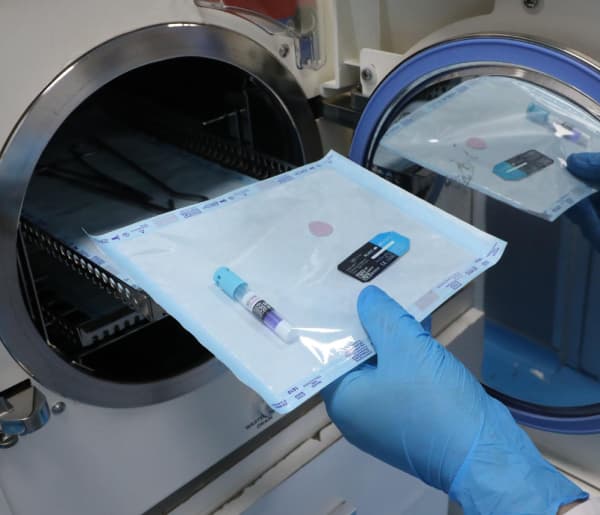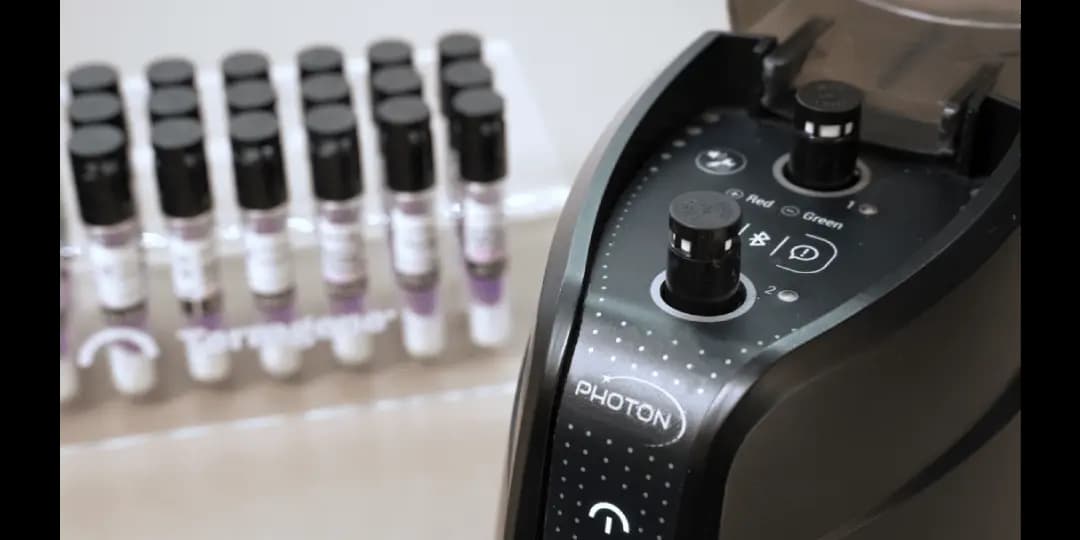
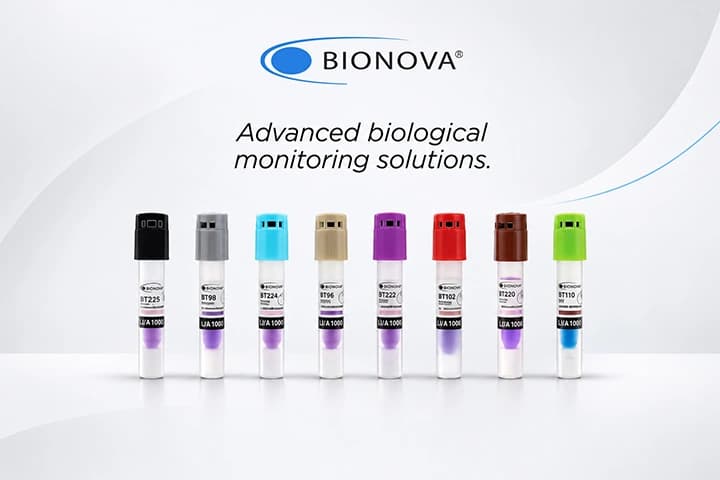
How can a biological indicator provide a result in seconds or minutes instead of days? Understanding the science behind rapid readout technology reveals why validated performance matters as much as speed.
In sterilization monitoring, time matters. Healthcare facilities need reliable information to evaluate sterilization processes, investigate unexpected results, and coordinate increasingly demanding workflows.
Traditional biological indicator methods may require extended incubation periods before results become available. (Spore strips: up to 7 days (reference method). Conventional SCBIs: 24–48 hours). Advances in detection technology made possible to obtain biological indicator results much faster, with validated readout times ranging from hours to minutes—and, for some steam sterilization applications, just seconds.
But what makes these rapid results possible? And how can professionals understand how a shorter readout time actually works?
The answers lie in the detection mechanisms behind biological indicators and the scientific evidence used to validate their performance.
This article is Part 2 of our Biological Indicators series. For an introduction to their role in sterilization monitoring, read Biological Indicators for Sterilization.
Table of Contents
What Determines Biological Indicator Readout Time?
Biological indicators (BIs) evaluate sterilization processes by challenging them with a defined population of resistant microorganisms, typically bacterial spores selected for the specific sterilization modality.
After exposure, the indicator must provide information about the biological response to the process. How that response is detected determines, in part, how quickly a result becomes available.
Conventional self-contained biological indicators generally rely on detecting microbial growth through changes in the growth medium, such as a visible color change associated with metabolic activity. This process requires sufficient time for surviving microorganisms to become detectable.
Rapid-readout technologies use different detection approaches to identify biological signals earlier, reducing the time needed to obtain a result.
However, a faster readout is not simply a shorter version of a conventional incubation period. It depends on the detection technology, its intended application, and evidence that supports its validated performance.
Understanding these differences is essential to interpreting what a rapid biological indicator result represents.
Different Technologies, Different Detection Mechanisms
Not all biological indicators detect the result in the same way.
Understanding their detection mechanisms helps explain how they can provide results within substantially shorter periods.
Conventional growth-based detection
In conventional self-contained biological indicators, the spore-containing carrier and growth medium are integrated into a single unit. After sterilization exposure, the indicator is activated and incubated according to the manufacturer’s instructions.
If viable spores remain, they can germinate and grow under suitable conditions. Their metabolic activity produces changes in the medium that can be detected, often through a visible color change.
This approach has an established role in biological monitoring, but detecting microbial growth requires time.
Enzime-bases Fluorescence detection
Some rapid-readout systems detect fluorescence associated with microbial viability.
This is possible because this spores contain a enzyme, when this enzyme act on a fluorogenic substrate, release a fluorescent compound. The reader interprets the signal with a validated algorithm. It is an indirect, rapid indicator of spore survival.
Rather than waiting for growth to produce a visible color change, these systems detect specific enzymatic activity using a fluorescence-based reaction and an appropriate reader.
By detecting the relevant signal earlier, fluorescence-based technologies can substantially shorten the time required to obtain a result.
For example, Terragene’s Bionova® BT98 provides a validated readout in 5 minutes for hydrogen peroxide sterilization, while the BT224 provides a validated readout in 20 minutes for steam sterilization (132–135 °C).
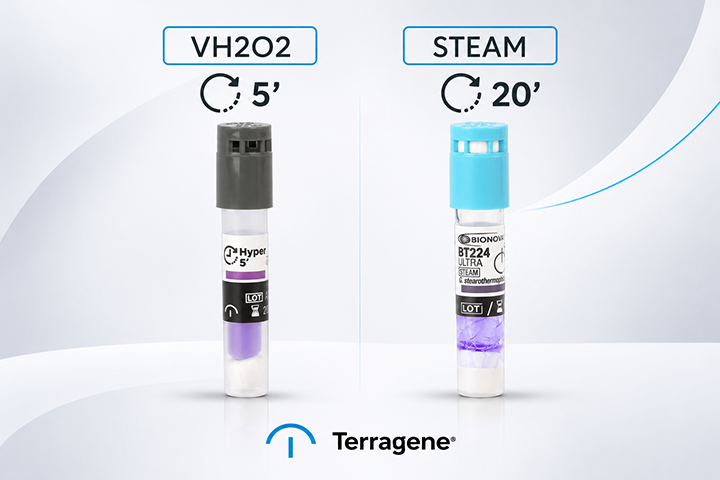
These examples illustrate how detection technology can be adapted to different sterilization processes and operational requirements.
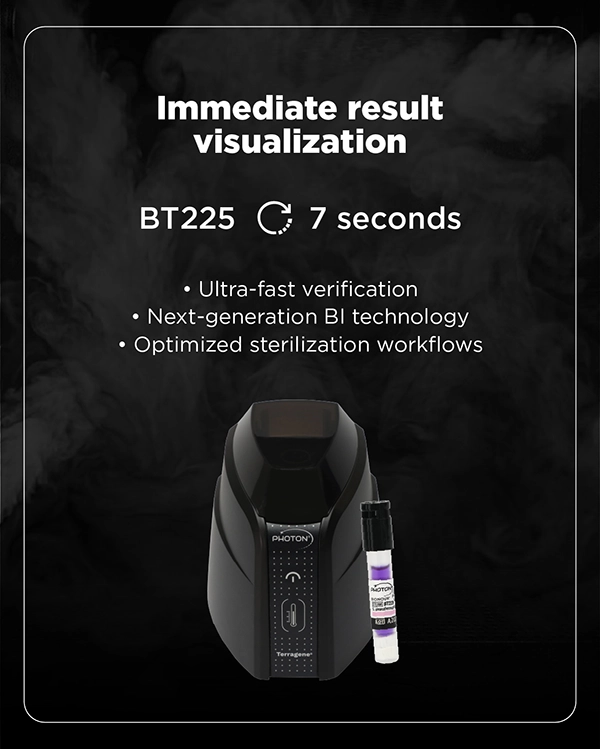
Protein based fluorescence detection: Bionova® BT225 PHOTON
Bionova® BT225 uses a different approach.
According to Terragene’s technical documentation, this indicator evaluates structural changes in spore proteins associated with effective sterilization exposure. When exposed to effective sterilization conditions, these proteins undergo changes in their 3 dimensional structure and native conformation. BT225 detects this change as an indication of the lethal effect of the process.
BT225 mechanism differs from conventional growth-based detection and from enzimatic-based fluorescence it detects structural changes in a scaffold protein, not enzymatic activity.
BT225 provides a validated readout in 7 seconds for steam sterilization.
The distinction matters: rapid biological monitoring is not a single technology, but a field of approaches designed to detect relevant biological signals within shorter, validated timeframes.
What Does a Validated Readout Time Mean?
Obtaining a signal quickly is not enough. The performance of a biological indicator must be supported by appropriate validation.
For rapid-readout systems, validation of a reduced incubation time is intended to demonstrate that the shorter period is sufficient to detect positive results under the conditions established by the applicable validation methodology.
The technical document Biological Indicators in Modern Sterilization Practice describes the reduced incubation time validation approach referenced in FDA CDRH guidance for biological indicator submissions. Reduced incubation time (RIT) is any incubation period shorter than 7 days. Its validation is described in ISO 11138-8.
The methodology described includes testing indicators from multiple manufacturing lots, exposing them to sub-lethal cycles, that result in 30- 95% positive growth at 7 days and comparing the results obtained during reduced incubation with those observed over a seven-day reference period.
The purpose is to establish that the shorter readout period can detect the positive results with an accuracy higher than 97%.
This is an important distinction. A validated readout time is not merely a manufacturer’s estimate of when a result might become visible. It is a performance claim supported by a defined validation process.
The applicability of a particular validation methodology depends on the product, its intended use, and the relevant regulatory context. Professionals should therefore consult the manufacturer’s instructions and applicable requirements when establishing monitoring protocols.
The value of rapid readout lies in combining speed with validated performance—not in speed alone.
A validated readout applies only to the biological indicator used with the reader specified by the manufacturer. Fluorescence BIs must be incubated immediately after activation and must never be re-incubated. A second incubation can produce a false negative on a true positive.
From Faster Results to Better-Informed Decisions
The practical implications of rapid biological monitoring extend beyond the time displayed by a reader.
In central sterile supply departments (CSSDs), workflows depend on coordinating sterilization cycles, monitoring activities, instrument availability, and the needs of clinical services.
When traditional biological indicator require extended incubation, the information may become available well after other cycle data have been reviewed.
Rapid-readout technologies can shorten this interval, providing earlier access to biological monitoring information.
Depending on the application and the facility’s established procedures, this can support:
- Earlier identification of unexpected biological indicator results.
- More timely investigation of potential process issues.
- Better coordination of monitoring activities and workflow planning.
- Faster access to information needed to evaluate sterilization performance.
- More informed operational decisions based on biological evidence.
Nevertheless, a shorter readout time does not automatically establish that a load can be released. Load release must follow the facility’s validated procedures, applicable regulations, product instructions, and established acceptance criteria.
Minimum criteria for load release: physical parameters passed, external chemical indicator passed and a negative BI.
Rapid readout changes when information becomes available. It does not eliminate the need to interpret that information correctly.
When Results Are Unexpected, Evidence Matters
Biological indicators provide information that should be evaluated alongside other relevant evidence about a sterilization process.
An unexpected positive result should not be dismissed even if all cycle parameters appear to be within specification.
Such a discrepancy should be investigation according to the facility’s established procedures. The investigation may include a review of the cycle record, indicator handling and activation, the monitoring equipment, and potential process-related factors.
A positive BI is treated as a failed load. A negative BI cannot be used to dismiss a positive one from the same load. The sterilizer shoul be quarantined and items reprocessed.
A fluorescence-positive, growth-negative result does not automatically mean a defective BI or autoreader. It can reflect the conservative security margin of fluorescence detection.
Rapid detection can help professionals identify an unexpected result sooner and begin the appropriate investigation without unnecessary delay.
However, speed does not replace professional judgment. Understanding the indicator’s detection mechanism, validated performance, and intended application remains essential to interpreting the result.
This is where scientific knowledge and practical experience come together: not simply to obtain a result, but to understand what it means and determine the appropriate next step.
Faster Detection. Informed Decisions. Stronger Sterility Assurance.
The evolution of biological indicator technology demonstrates how scientific advances can change the way sterilization processes are monitored.
From conventional growth-based systems to enzyme-based fluorescence and protein, protein-based fluorescence, different technologies offer different ways to obtain biological monitoring results within validated timeframes.
Their value depends on more than how quickly they produce a signal. It also depends on the science behind the detection mechanism, the validation supporting the readout time, and the correct interpretation and use of the results.
For sterilization professionals, understanding these principles is essential to evaluating monitoring technologies and integrating them appropriately into established quality assurance practices.
At Terragene, the development of biological monitoring solutions connects microbiological principles with technological innovation to support professionals in obtaining meaningful information about sterilization processes.
Because when it comes to sterilization monitoring, faster results matter—but the evidence behind them matters just as much.
Want to learn more about biological indicators and their role in sterilization monitoring? Watch our webinar on demand and explore the fundamentals of biological monitoring.