
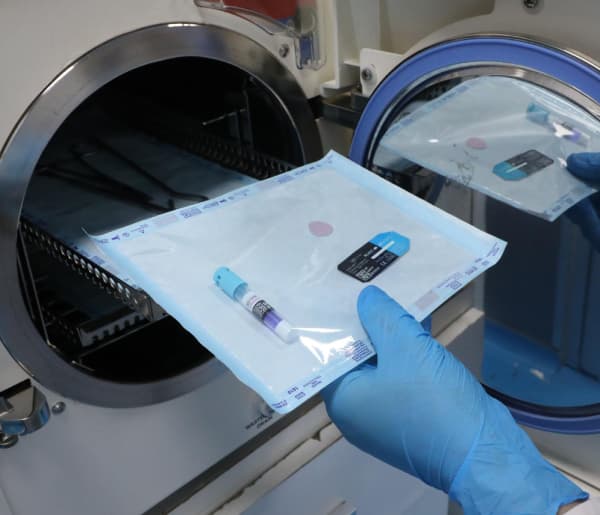
A biological indicator (BI) is a microbiological test system that carries a defined, known population of highly resistant bacterial spores and is used to confirm that a sterilization cycle killed living microorganisms — not just that it reached certain parameters. Where a chemical indicator only reacts to a certain group of chemical and/or physical conditions of the cycle, a biological indicator measures the one outcome that actually matters: whether life survived the process.
That distinction is why biological indicators for sterilization remain the reference method across hospitals, sterile processing departments, and pharmaceutical manufacturing, This note walks through the science behind biological indicators, how self-contained biological indicators (SCBIs) evolved, and how Terragene’s Bionova® product line applies rapid fluorescence detection to shorten a result that used to take a week into one that can take seconds.
What Is a Biological Indicator?
Bacterial endospores are the foundation of biological indicator technology. Sporulation is a dormancy strategy that bacteria trigger under nutrient stress, and the resulting spore form is extraordinarily resistant to heat, chemical agents, and radiation while remaining stable in storage and able to germinate reliably once conditions turn favorable. Those three properties — resistance, storage stability, and reliable germination — are exactly what make bacterial spores suited to monitoring a sterilization process.
Biological indicators are manufactured using species from the genus Bacillus and Geobacillus. International standards (the ISO 11138 series) and pharmacopeial references (USP) specify which organism should challenge which sterilization process:
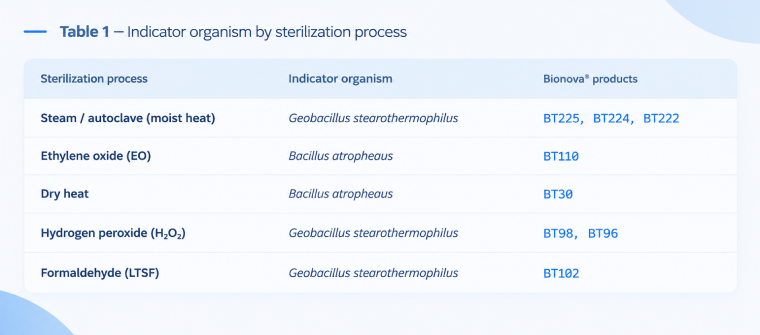
Geobacillus stearothermophilus is the predominant organism for steam and hydrogen peroxide monitoring: a thermophile with an optimal growth range of 55–60°C. For steam BIs conforming to ISO 11138-3, the minimum D-value must be at least 1.5 minutes with a Z-value of at least 6°C. Bacillus atrophaeus, a mesophile optimal at 30–39°C, is the reference species for EO and Dry heat, with minimum D-values set by ISO 11138-2 and ISO 11138-4 respectively.
The Science Behind Biological Indicators
D-value, Z-value, and the survivor curve
Two parameters quantify how resistant a biological indicator’s spore population is. The D-value is the exposure time or dose needed to achieve a 90% (1-log) reduction in the viable spore count. The Z-value, which applies to thermal processes, is the temperature change that produces a tenfold change in D-value. Plotted together, they describe the survival curve — a semi-logarithmic plot of viable spore count against exposure time that, under ideal conditions, follows first-order inactivation kinetics.
These aren’t abstract numbers: they’re the basis for calculating sterility assurance and for designing cycles with an adequate safety margin. Regulatory guidance recommends that D-values be established on the final finished product with a resistometer tested across at least three different spore lots from different spore crops.
From Spore Strips to Self-Contained Biological Indicators (SCBIs)
Self-contained biological indicators are a design step beyond the original spore-strip format. In an SCBI, the spore carrier and a growth medium sit sealed inside a single hermetic unit. After exposure, the user activates the unit — typically by crushing an internal ampoule to release the medium — and incubates it at a validated temperature. this sealed unit removes the risk of cross contamination and means every user reads the result under the same controlled conditions the manufacturer validated.
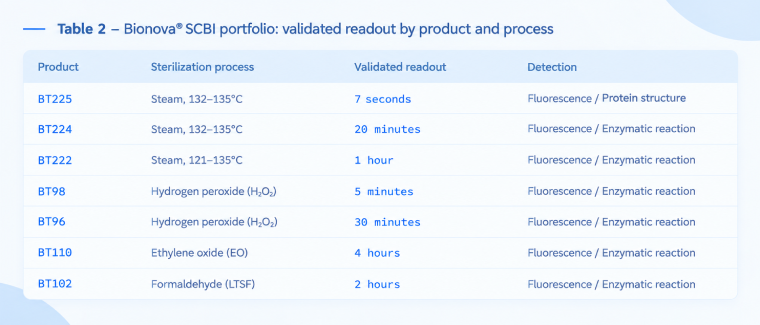
Conventional Bionova® SCBIs use pH-sensitive chromogenic indicators in the growth medium: surviving spores produce acid byproducts that trigger a visible color change. The rapid Bionova® line instead uses enzyme-based fluorescence detection, generating a fluorescent product within minutes — well before the turbidity or pH shift a colorimetric read depends on, without giving up sensitivity or specificity. The fastest model, BT225, works differently again: it targets the structural denaturation of heat-stable spore proteins as a direct proxy for spore inactivation, which is what gets its readout down to 7 seconds.
Rapid Readout Technology: From 7 Days to 7 Seconds
The reference incubation period for a biological indicator is 7 days, per ISO 11138-1 §7.3. Terragene’s Bionova® rapid-readout portfolio spans a much wider range — from 7 seconds for steam up to 4 hours for ethylene oxide — letting a facility pick the product that fits its process type, throughput, and regulatory setting.
Steam sterilization (autoclave)
An unexposed control BI with a full spore population typically shows positive growth within 3–4 hours using a conventional colorimetric method. BT225’s 7-second readout and BT224’s 20-minute readout compress that timeline by orders of magnitude by detecting the relevant marker long before visible turbidity or pH change appears, while BT222’s 1-hour readout offers a lower-cost middle ground.
Hydrogen peroxide sterilization
For heat-sensitive devices like endoscopes, BT98’s 5-minute readout can confirm sterility faster than it takes to move the processed load to the point of use; BT96’s 30-minute readout is the option when that slightly longer window isn’t a constraint.
Ethylene oxide and formaldehyde (LTSF)
BT110 brings EO confirmation down to 4 hours, a sharp cut from the 48-hour or 7-day incubation these loads have traditionally required before release. BT102 reads formaldehyde (LTSF) cycles in 2 hours, supporting facilities running low-temperature steam-and-formaldehyde sterilization.
Reduced Incubation Time (RIT): How It’s Validated
A validated reduced incubation time is what allows an SCBI to report a result well before the 7-day reference period elapses, and it isn’t an informal shortcut — it follows a defined methodology. The FDA CDRH’s 2007 guidance on biological indicator 510(k) submissions requires exposing a minimum of 300 BIs (100 from each of three separate manufacturing lots) to partial sterilization cycles engineered to leave 30–80% spore survival. Every BI is incubated for the full 7-day reference period with daily scoring, and the validated RIT is set as the greatest number of incubation days needed for any single lot to reach 97% or more of that lot’s total 7-day positive count.
Results are never averaged across lots — the most conservative lot sets the minimum incubation time. That conservatism matters because it’s designed to hold even in a worst case: if only a single spore survives a near-lethal exposure, the validated incubation window still gives that lone survivor enough time to germinate, multiply, and produce a detectable positive signal.
Sterility Assurance Level (SAL) of 10⁻⁶, Explained
The Sterility Assurance Level is defined as the probability of a single viable microorganism remaining on a product after sterilization. For terminally sterilized medical devices and pharmaceutical products, the internationally accepted target is an SAL of 10⁻⁶ — a probability of no more than one non-sterile unit per million units processed.
The overkill method
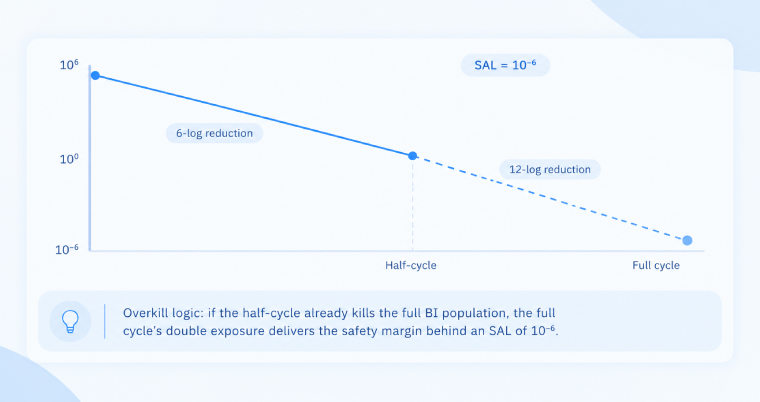
The most widely used validation strategy is the overkill approach. A BI carrying a known population — typically 10⁵–10⁶ CFU of an organism far more resistant than any expected bioburden — is used to show that a half-cycle (50% of the full exposure time) is already enough to fully kill every BI. The full cycle then delivers at least double that lethality, which is the safety margin behind the SAL claim.
Regulatory guidance sets minimum spore populations and D-values for cleared BIs: for steam at 121°C, a minimum of 10⁵ spores with a D-value of at least 1.5 minutes and a survival time of at least 5 minutes; for EO at 600 mg/L, 54°C, 60% RH, a minimum of 10⁶ spores with a D-value of at least 2.5 minutes. Terragene’s rapid Bionova® models (BT225, BT224, BT98, BT110, BT102) are manufactured to meet or exceed these benchmarks, with every lot characterized against ISO 11138 across multiple spore crops before release — a faster readout does not mean a smaller resistance challenge.
Why Biological Indicator Placement Matters
A reliable SAL result depends on where the biological indicator sits inside the sterilizer, not just on the indicator itself. In a published investigation it was shown, in a real production cycle (6,480 units), that the equivalent process time (F-value) varied across chamber positions from 19.5 to 23.5 minutes. With a D-value of 2 minutes, that 4-minute spread already corresponds to a 2-log difference in spore kill between the least and most lethal locations. In large or thermally massive loads, the gap can reach 10–12 equivalent minutes — a difference of several orders of magnitude in SAL within the very same cycle.
The practical takeaway: placing a BI without systematic lethality mapping is, in the author’s own words, a dangerous hypothesis. Only mapping identifies the true worst-case (minimum-lethality) location, and only there does a BI give a trustworthy SAL validation. A precise, standardized BI is what allows biological inactivation to be accurately correlated with that mapped physical lethality — placed incorrectly, it can overestimate the true SAL by two or more log orders.
Practical Applications
Routine monitoring in hospital CSSDs
Day-to-day monitoring places one SCBI per sterilization load alongside an unexposed control unit; both are activated and incubated after the cycle. The control has to show positive growth to confirm the spore population was viable, while the exposed BI should read negative at the end of the validated incubation window. With BT225, a steam load can be biologically confirmed before the instruments even reach the point of use; for H₂O₂ sterilization of heat-sensitive devices, BT98’s 5-minute readout can beat the time it takes to move the load to the operating room.
Sterilization validation with the overkill approach
Initial validation typically runs three consecutive half-cycle exposures with BIs placed at the identified worst-case locations; all of them need to show no growth to demonstrate the half-cycle alone is lethal enough. Because the full cycle doubles that exposure, this establishes the safety margin behind the SAL 10⁻⁶ claim. Where a traditional protocol required a 7-day hold between validation runs to confirm results, rapid products such as BT224 or BT98 let a facility confirm a run and move on to the next one the same day.
When a biological indicator tests positive
One of the harder situations in sterilization practice is a positive BI in a cycle where every physical parameter looks normal. That discordance usually points to something the instruments alone can’t see — trapped air pockets in a porous steam load, or insufficient humidification inside an EO load, for example. The right response is never to dismiss the biological result: a BI integrates every lethal and sub-lethal condition it actually experienced at its location, which makes it the most complete single indicator of how the process really performed. A rapid readout just means that investigation can start within minutes instead of days.
From spore biology to regulatory compliance, one principle holds: a biological indicator is only as trustworthy as its science, its placement, and its validation. Terragene Bionova® SCBIs bring rigor and speed together — turning sterility assurance from a multi-day wait into a near-real-time certainty.
Read the full article here.